![[LOGO]](logomhi2.gif)
Carmarthen United
An example of undercapitalisation in a mid 19th century lead venture.
Peter Claughton, 1994.
An example of undercapitalisation in a mid 19th century lead venture.
Peter Claughton, 1994.
Using recently discovered documentary evidence, this paper examines the operation of a small lead mine in west Wales. Identifying a lack of working capital which hampered chances of success during a period of relatively high lead prices.
The late 1850s saw an increased investment in lead mining prompted by the high price of lead. With the introduction of limited liability status in 1855, along with the Companies Act of the following year, the way was opened for low risk investment in mining; stimulating the formation of a number of small companies to work mines in many of the less well known areas.
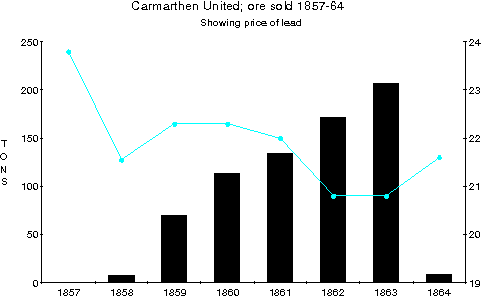
In 1853 the price of pig lead had jumped from £17 15s 6d (£17.77) to £23 8s 0d (£23.40) per ton, eventually peaking at £24 in 1856. This increase had been generated by a buoyant domestic market and increased exports at a time when the effects of the Crimean War was reducing imports. Although prices fell back slowly after 1856 as imports again increased, they remained relatively high for a number of years. The consequent increase in the price paid for lead ores was to make a number of what had been regarded as poor or marginal mineral deposits appear as good investments. No more so than on the Carmarthen - Pembrokeshire border where the small Trelech lead mine appeared set to emulate its larger neighbour Llanfyrnach.
Although undoubtedly the site of a much earlier working the Trelech mine was opened up as Carmarthen United in about 1855 / 56 at the lead price peak. Leases of 30 years being taken on a sett encompassing the farms of Cwm and Cileynon, the latter being part of a larger holding Gwndwn; with activity centred on the steep east side of the Afon Cynig, one and three quarter miles south west of Trelech village, at NGR SN 263.237.
The company formed to work the mine was probably a cost book company, later referred to as 'the old company', under the direction of Messrs Williams, Hand and Harrison. An engine shaft (initially referred to as Harrison's) was sunk on the hillside close to the Cwm / Cileynon boundary. Down to the 7 fathom level by November 1857, it was initially drained by horse whim and kibbles although a water wheel pit was in the course of construction. Stores and a house were also erected. The adit driving north was showing signs of lead ore, but the primary task was to get under old workings below adit, following an ore shoot dipping south of the engine shaft, on what was to be called the Main Lode.
In January 1858 the company was reformed as a limited liability company, The Carmarthen United Lead Mining Co. Ltd., with a nominal capital of £12,900 divided into 2580 shares of £5 each. £4.50 per share was called up immediately netting £11,610; the total of which was paid to the old company for the leases and the structure of the mine.
It was with this move that the mine's problems really began. Limited liability had been incorporated in the Companies Act of 1856 and had an advantage for the small investor over the earlier cost book and joint stock companies where any one shareholder could be sued for the total company debt. However the amount of capital which could be raised was set in the articles of association; it was not open ended as it had been with a cost book company.
Thus having paid for the mine the new Carmarthen United company was left with only £1290 as potential working capital. £1032 of this was called up, in four calls of 2s (10p) per share, within a few months to pay for a 24 foot pumping water wheel and settle outstanding wages to the end of May. However, by the middle of July over £600 was due on merchants' bills and miners' wages for June, and little or no production had taken place.
There is little doubt that too much was paid to the old company for the mine. But it appears that the intention was to continue running the company along the lines of its predecessor, calling up capital as required, and the purchase price represented reimbursement of costs to the old shareholders who would be expected to take shares in the new company. Arrears of calls made by the old company, along with their cash balance, appear as assets in the accounts of the new, limited liability, company. Under the mistaken impression that the company could operate in that manner, yet have the full benefit of limited liability, they failed to make adequate provision for working capital.
Once the available capital had been realised, and there is evidence that shares were more than fully paid up with calls totalling £5.40 per share to February 1860, the company had to resort to loans from individual shareholders and a mortgage on the mine. A total of £957 was raised in this manner supplementing the revenue from ore sales but that was only sufficient to pay working costs to November 1859. From that date the company operated on merchants' credit and the miners went unpaid.
The situation came to a head in March 1860 when the miners withdrew their labour. With no monies being forwarded by the company their agent, Captain Robert Sanders, also manager at Llanfyrnach and resident at that mine, had been advancing them money from his own pocket. But that proved insufficient even with a local shopkeeper, David Rees, allowing them provisions on credit.
By that date the engine shaft was down to the 32 fathom level, sunk on the underlay of the main lode about 1.5 feet in the fathom; now pumped by a new 34 foot water wheel. Increased water in the workings had been beyond the capacity of the 24 foot wheel, which was relegated to working the crusher. By fortune or design the company had brought in their leat at sufficient height to run water over two wheels. The new pumping wheel being installed directly down slope from the shaft collar; working a short run of flat rods to an angle bob fixed in a stone arched housing in the shaft head. Water from that wheel then ran directly onto the crusher wheel before exiting through a stone arched tail race at river level. The masonry structures housing this arrangement still survive on the site.
Nine partnerships had been engaged in deadwork and raising ore on tribute; along with 28 other persons working in the engine shaft, at surface and on the dressing floors, on day wages. In total they were owed over £750 for activities during the five months to mid March. Some of the men having appointed David Rees, the shopkeeper in Trelech, as their agent; a Carmarthen solicitor. J B Jefferies, was engaged to recover the monies due from the company. (Appendix One)
Jefferies at first considered suing the company; but once it was evident that their capital was more than called up, he, with the clandestine support of Captain Sanders who as agent was also owed a sizeable amount in salary, approached William Darling the company secretary who was trying to raise fresh capital. The mine had already been offered for sale by auction but as there was apparently no interest it was withdrawn and in the early part of April a subscription of £1 per shareholder was negotiated, which funds were used to pay the miners up to the end of February; one of the directors making a personal guarantee for the March pay.
This was sufficient to get the miners back to work and by the summer of 1860 prospects for the mine were quite good. Output of ore had slowly risen to a point where the mine was virtually paying its way and if sufficient capital had been available that point might have been reached much sooner. As it was break even was not achieved until June 1861, by which time it had been necessary to borrow another £1250.
In mid 1861 the mine was being worked at the 42 fathom level and shortly afterwards a rich ore body was cut at that level on the main lode north of the engine shaft. This discovery, lying under the Cileynon section of the mine, was to sustain the mine for the next three years. The orebody was cut in the 66 fathom level in July 1863 but progress beyond then is not known as reporting in the Mining Journal ceased. Dressing of ore at least continued until late February 1864, resuming again briefly in July of that year; by which time a new company, Trelech Lead Mining Co. Ltd., had been formed to take over the leases. One lot of ore, 8tons 9cwt, was offered for sale on November 30th but this no doubt represented the final dressing of material left on site and was not fresh mined. It is evident that this new company was not successful as it was replaced by another, Trelech Mines Ltd, in the following year. Nor was this a success. Further attempts to rework the mine in the 1870s came to nothing and in the period 1882 to 1891 it was in the hands of L H Evans, the lessee at Llanfyrnach, who no doubt investigated the site but apparently never worked it. (1)
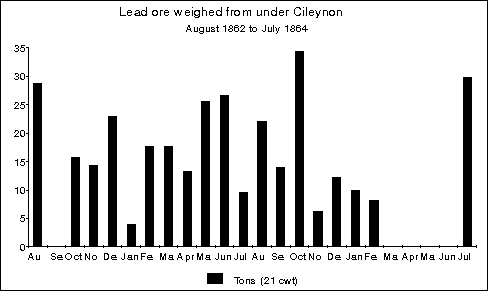
The reason for failure in 1864 are not known for certain; the final report refers to a crosscourse which apparently cut off the lode, in which case the lack of working capital would have seriously hampered any attempt to identify and regain the profitable ore body. Mining was, and remains, a speculative business and without sight of ore few would invest new money in a mine when the trend in lead prices was downward. Carmarthen United had produced over 692 tons of lead ore, dressed to 75% metal content, averaging about £13.50 per ton; plus at least 18.5 tons of second grade ore which realised around £3 less. The total being much higher than that credited to the mine in the official Mineral Statistics. As shown in the graph of ore sold, production was steadily increasing; expectations must have been high and a better financed mine might have recovered.
The various claims for wages due (Appendix One) illustrate the casual nature of employment in a small mine. Apart from three or four of the partnerships few of the miners were working at Trelech full time, only the female lead dressers put in a regular appearance. The few men who appear for March only perhaps replaced others who left, frustrated by non payment of wages. Many of the miners were locally born and no doubt had access to alternative agricultural employment. For others the nearby Llanfyrnach Mine offered a more stable future and when Trelech did close many moved on to that mine. Over the next three decades fewer immigrant miners are in evidence and the larger mine could call on an indigenous workforce from the surrounding parishes.
John Reed and partners  [in detail]
Nov. 1859	Sinking winze 1 fathom 5 feet at £3 15s	 	£6 17s 6d
		Sinking winze	2 fathoms  at £3 3s  		£6   6s 0d
							          		£13  3s 6d
		Deduct mine materials			  	£3  1s 3d	£10 2s 3d
Feb. 1860	Raising lead ore  15 ton 7 cwt 1 q
			at £3 5s per ton			£49 18s 63/4d
		Deduct mine materials				£11 14s 6d	£38 4s 03/4d
Mar. 1860	Raising lead ore  6 ton at £5 per ton		£30  0s  0d
		Working at surface 14 days at 2/6		 £1  15s 0d
		Deduct mine materials			 	£7  0s  61/2d	£24 14s 6d (sic)
										£73  1s  03/4d

John Andrews and partners [in precis thereafter]
Dec. 1859	Sinking winze; hanging tackle; and repairing stull
Jan. 1860	Sinking winze; extra for holing winze; and stoping at 32.	£48  0s  8d

William Davies
Dec. 1859			One days work at 2/6 per day
7 Feb. to 2 Apr. 1860  	Eight weeks work at £1 per week		  		£8  2s  6d

Thomas Rees and partners
Nov. 1859	Driving 32 north; cutting barrow road; and assisting
		shaft men.
Dec. 1859	Driving 32 north; crosscutting;
Jan. 1860	Driving 32 north; crosscutting; and sundry jobs			£49 17s  8d

Jonah Thomas
Dec. 1859			One day at 2/6
Jan. 1860			Two days at 2/6
Feb. 1860			Eight days at 2/6				£1  7s  6d

James Mitchell and partners
Feb. 1860	Driving the 22 north; taking down lode and clearing stuff.
Mar. 1860	Driving 22 north; crosscutting west				£12  1s  9d

David Jones
Nov. 1859 to Mar. 1860   	Carrying parts  22 weeks at 2/-, 1 at 1/6	£2  3s  6d

Margaret Miles
Nov. 1859 to Mar. 1860 	  111 days at 1/-				  	£5 11s  0d

John Rees (boy)
Nov. 1859 to Jan 1860	493/4 days at 8d				   	£1 13s  2d

Wm. Edwards
Mar. 1860			Ten days at 2/6				   	£1  5s  0d

Elizabeth Davies
Nov. 1859 to Feb. 1860	72 days at 1/-					   	£3 12s  0d

Anna Evans
Nov. 1859 to Mar. 1860	1141/2 days at 9d				   	£3 19s 01/2d

Sarah Thomas
Nov. 1859 to Mar. 1860	831/4 days at 9d and 243/4 days at 10d		  	£3 18s 111/4d

David Davies (Rhos)
Nov. 1859 to Jan. 1860	Filling kibble 393/4 days at 2/6		   	£7  9s  41/2d

Anne Thomas
Mar. 1860			221/4 days at 11d				£1  0s  43/4d

Martha Evans
Nov. 1859 to Mar. 1860	96 days at 8d				               	£3  4s  0d

Ann Pearce
Nov. 1859 to Mar. 1860	110 days at 14d				   		£6  8s  4d

John Jones (Crib)
Nov. 1859 to Mar. 1860	Nine days at 2/6				  	£1  2s  6d

Henry John
Mar. 1860			Eight days at 2/6                               £1  0s  0d

Wm. Thomas (Horse hire)
Nov. 1859	Carriage of 22 cwt of coals at 41/2d; 5 barrels of
		coals at 1/-;load of slate; 11 tons of lead at 7/6.
Dec. 1859	Carriage of 11 barrels of coal; 18 cwt of coal;
		Carriage of lead from station, two days at 4/6;
		steel and bags to the mine.
Jan. 1860	Carriage of 14 cwt coals; 11 barrels of coals;
		12 tons of lead.
Feb. 1860	Carriage of 14 cwt coals at 8/6 per ton;
		9 cwt of coals at 7/6 per ton; 71/2 barrels of coals
		at 1/2; powder and candles; powder from Glandwr;
		lead to vessel, one day; 2 tons of lead at 7/6; 4 tons
		of lead at 8/6.
Mar. 1860	4 barrels of coals at 14d; 21 cwt of coals at 41/2d;
		candles, oil &c.; iron &c.					£16 14s  21/2d

Shem Evans
Nov. 1859 to Mar. 1860	24 days at 2/6 and 751/4 days at 2/-			£10 10s  6d

Thomas Evans
Nov. 1859 to Mar. 1860	653/4 days at 8d and 20 days at 9d		  	£2 18s 10d

Henry Davies
Nov. 1859 to Mar. 1860	Landing and masonry, 46 days at
				2/6 and 101/2 days at 3/-
Henry Davies (junior)
Mar. 1860			Three days at 1/8
				deduct dials and club			  	£7 11s  0d

David Davies (carpenter)
Dec. 1859 to Mar. 1860	643/4 days at 3/-			 	  	£9 14s  3d

William Hughes
Feb. 1860 to Mar. 1860	Dressing, puddling &c., 483/4 days
				at 9d.					  	£1 16s  63/4d

John Hughes
Nov. 1859 to Mar. 1860	Filling the kibble, 119	3/4 days
				at 2/6.					 	£15 14s  41/2d

John Jones
Nov. 1859 to Mar. 1860	Working machine, 1253/4 days
				at 2/6.					 	£15 18s  61/2d

Henry Thomas (farmer)
Nov. 1859	Carriage of 255 feet 4 inches of timber at 31/2d
Jan. 1860	Carriage of 14 qrs of lime at 1/6
Feb. 1860	Carriage of 135 feet of timber at 31/2d		 	  	£6 14s 10d

Ben James
Mar. 1860			Eight and a half days at 7d		            4s 111/2d

Henry Jones
Jan. 1860 to Mar. 1860	391/4 days at 2/- and 23 days at 1/8	  	  	£5 18s 10d

John Jones (lander)
Dec. 1859 to Mar. 1860	53 days at 2/3; 24 days at 2/-; and
				261/2 days at 1/6.			 	£10  7s  6d

John Jones (No. 2)
Jan. 1860 to Mar. 1860	36 days at 2/6				  	  	£4 10s  0d

Richard Munday and partners
Nov. 1859	Driving crosscut at 22 west 6 fms 4 ft 6 in
		Deduct mine materials
Jan. 1860	Driving on Caunter Lode at 22 6 fms 4 ft
		Rising 3fms; crosscutting 2ft 6 in
		Deduct mine materials					  	£39  6s  2d

Richard Reynolds and partners
Nov. 1859	Driving 22 north 8 fms 0ft 6in; crosscutting lode
		Deduct mine materials
Dec. 1859	Driving 22 north  5fms 3ft
		Deduct mine materials
Jan. 1860	Driving 22 north 3 fms 2ft 9in
		Deduct mine materials					 	£51  8s  41/2d

David Rees (Horse labour)
Nov. 1859	Horse 2 days at 2/6
Dec. 1859	Horse 6 days at 2/6; bringing parcels from
		Carmarthen; 1 day going to William Howells.
Jan. 1860	Horse 2 days at 2/6
Feb. 1860	Horse 2 days at 2/6
Mar. 1860	Horse 2 days at 2/6

John Lewis and partners
Nov. 1859 to Mar. 1860	Raising lead ores  11 tons 20cwt 1 qr
				Sinking winze 3 fms 2 ft
				Deduct mine materials		 		£48 17s  41/4d

Shem Davies and partners
Mar. 1860	Raising 13/4 tons of lead; driving crosscut west 1 fm;
		sawing one day.					   	  	£9 12s  0d

James Munday and partners
Nov. 1859	Dividing and bed planking shaft; cutting plat in 32;
		clearing up fork and cistern; driving 32 south 2 fms
		4ft 6in.
		Deduct mine materials				 	 	£22  3s  5d
Dec. 1859	Driving 32 south 5fms 2ft 3in; stoping 2fms 6ft 6 in;
		deduct mine materials.				 	 	£26  7s  8d
Jan. 1860	Driving 32 south 5fms 3ft 3in; rising against
		winze 1 fm 0ft 6in; stoping back of plat.
		Deduct mine materials.				 	 	£23  0s  7d
Feb. 1860	Sinking Engine Shaft 1fm 5ft 6in at £11 per fm.;
		cutting plat for and fixing cistern; putting in
		penthouse hanging tackle.
		Deduct mine materials.					 	£25  4s 10d
Nov. 1859 to Feb. 1860	James Munday pitwork, 4 months.	   	   		£4  6s  8d
Nov. 1859 to Feb. 1860	Watching, 4 months.			   	   	£4  0s  0d
Mar. 1860	Sinking Engine Shaft 2fms 3ft 9in.
		Deduct mine materials
		Pitwork, 1 month
		Watching							£24 16s  6d
 These pages are still in the course of construction work. The owner apologises for any missing links.